
All conservation projects need a plan phase
Jan 27
/
Adam Barlow
Quick answer
The Plan phase creates the complete project blueprint before any conservation work begins. It mobilises the planning team, establishes core management processes, and produces a signed-off Project plan that documents your conservation strategy, monitoring approach, roles, stakeholder engagement, risks, work plan, and budget.
Unlike jumping straight into fundraising or fieldwork, the Plan phase ensures you have a defensible strategy that explains how your work will achieve biodiversity impact and a realistic plan for delivering it.
Unlike jumping straight into fundraising or fieldwork, the Plan phase ensures you have a defensible strategy that explains how your work will achieve biodiversity impact and a realistic plan for delivering it.
The Plan phase approach described here is the first of five phases in the Project Management for Wildlife Conservation best practice, the peer-reviewed standard used by conservation professionals worldwide to deliver measurable biodiversity outcomes.
UNLOCK OUR FULL BEST PRACTICES AND GET CERTIFIED CONSERVATION SKILLS
Ready to go deeper?
Build practical skills for wildlife conservation by exploring our expert-led courses designed to help you apply what you’ve learned in real-world contexts. From career development to technical conservation tools, our training is built to support your next step.
Contents
-
Why most conservation projects fail before they start
-
The five Plan phase activities explained
-
What the Project plan actually contains
-
Why sign-off matters more than you think
-
The phase-end meeting that launches everything else
-
How Plan phase connects to other project phases
-
FAQ
Why most conservation projects fail before they start
Most conservation projects begin with enthusiasm but without a plan. A team identifies a conservation problem, immediately starts applying for grants, and begins work as soon as money arrives. Six months later, they realise their strategy doesn't address the main threats, their budget massively underestimates actual costs, key stakeholders actively oppose their work, and nobody clearly owns responsibility for delivering results.
This pattern repeats across the conservation sector. Research shows that over 70% of conservation grant proposals get rejected because the project plan fails to convince donors the work will achieve its claimed impact. Projects waste hundreds of thousands of pounds on activities that feel productive but achieve no measurable conservation outcomes because nobody mapped out how those activities would lead to biodiversity results before starting.
The fundamental problem is treating planning as an obstacle to overcome rather than the foundation for success. Teams confuse having an idea with having a plan. They mistake a list of activities for a strategy. They assume they can figure out implementation details once funding arrives, not realising that donors reject proposals precisely because those implementation details are missing.
The Plan phase solves this by forcing systematic thinking before any money is spent or fieldwork begins. It creates a complete blueprint that explains what you aim to achieve, why your approach will work, how you'll know if you're succeeding, who will do what, how you'll manage risks, and what resources you need. This blueprint becomes the Project plan that donors evaluate, teams implement, and directors use to assess progress.
The five Plan phase activities explained
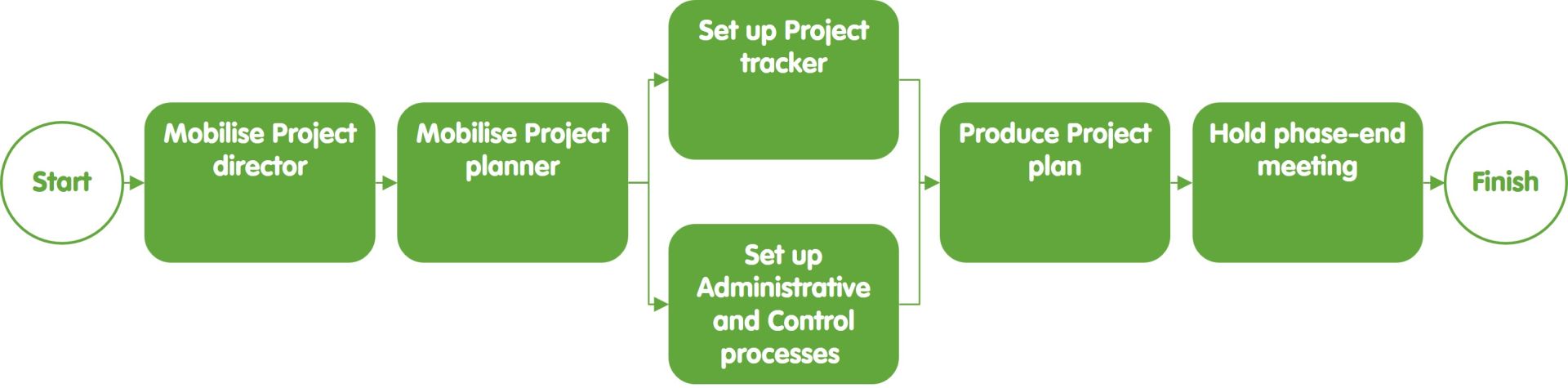
The Plan phase follows a specific sequence of five activities, each building on the previous one:
Mobilise Project director starts the phase by assigning someone ultimate accountability for project success or failure. If your conservation organisation has a Leader role above project level, they mobilise the Project director. If there's no Leader, whoever is initiating the project assigns themselves as Project director. This person will be accountable for whether the project delivers its promised conservation impact within budget and schedule, so they need authority to make decisions about project direction and resource allocation.
Mobilise Project planner brings in the person who will carry out the day-to-day planning work. The Project director mobilises and line manages the Project planner, creating clear accountability. The Project planner doesn't make final decisions about project direction, but they do the detailed work of developing the strategy, documenting processes, compiling the Project plan, and coordinating with stakeholders during planning.
Set up Project tracker creates the management tool that will track all project work from Plan phase through Close phase. The Project planner sets up this tracker, which captures activities, milestones, tasks, risks, issues, opportunities, lessons learned, meeting notes, decisions, and actions. Unlike a generic spreadsheet, the Project tracker is specifically structured to support the control and administrative processes that keep projects on track.
Set up Control and Administrative processes establishes how the project will actually be managed. Control processes define how you'll manage risks, issues, opportunities, lessons learned, and changes to the Project plan. Administrative processes define how you'll produce documents, manage meetings, and maintain filing systems. The Project planner sets these up during the Plan phase, though they'll be adjusted later by the Project manager during the Prepare phase based on implementation needs.
Produce Project plan creates the comprehensive blueprint document that will guide everything else. The Project planner produces this document following the specific content structure and quality standards defined in the Project Management for Wildlife Conservation best practice. The Project plan includes your conservation strategy, monitoring and evaluation approach, roles and responsibilities, stakeholder engagement plan, risk register, work plan, budget, and references. The Project director must sign off this document because they're accountable for project success, and once signed off, the plan can only be changed through formal change management processes.
Hold phase-end meeting closes the Plan phase and authorises moving to the Fund phase. The Project planner arranges this meeting with the Project director and presents two pieces of evidence: the signed-off Project plan and a Phase-end report summarising what was accomplished during planning. The Project director reviews this evidence and either authorises starting the Fund phase or requests additional planning work.
These activities must happen in sequence. You cannot produce a Project plan before setting up the processes needed to manage its development. You cannot hold a phase-end meeting before completing the Project plan. The sequence ensures nothing important gets skipped.
What the Project plan actually contains
The Project plan is not a simple document. It's a comprehensive blueprint containing multiple interconnected sections:
Conservation strategy section documents your current situation diagram showing biodiversity targets, threats, behaviours, and influences, plus your planned change diagram showing planned results and work packages. This section explains the cause-and-effect logic connecting your activities to conservation impact, making it the foundation for convincing donors your project will work.
Monitoring and evaluation section defines how you'll measure progress toward planned results for biodiversity targets, threats, behaviours, and influences. It specifies indicators, data collection methods, analysis approaches, and reporting schedules. Without this section, you cannot demonstrate whether your work is achieving its intended impact.
Roles section defines who does what throughout the project. It names the Project director, Project manager, Workstream leaders, and Workstream members, documents reporting lines, and clarifies decision-making authority. This prevents the "everyone's responsible so nobody's responsible" problem that derails many conservation projects.
Stakeholder engagement section identifies all stakeholders who can affect or will be affected by your project, assesses their power and interest, and plans specific engagement activities for each stakeholder group. Ignoring stakeholders during planning creates opposition during implementation that can stop projects entirely.
Risks lists all significant risks that could prevent you achieving your planned impact, assesses their likelihood and consequence, and documents mitigation actions. Donors evaluate your risk management capability when deciding whether to fund your proposal, so weak risk registers lead to rejected applications.
Work plan breaks down each work package into activities with start dates, durations, dependencies, and resource requirements. This shows donors you understand the practical complexity of implementation and have a realistic schedule.
Budget itemises all costs for delivering the work plan, broken down by work package and cost category. It includes staff time, equipment, travel, training, and overhead costs. Unrealistic budgets that underestimate costs or overestimate efficiency kill projects during implementation.
References section lists all information sources used to develop your conservation strategy, threat assessments, behaviour analysis, and work package design. This demonstrates your plan is based on evidence rather than assumptions or wishful thinking.
Each section depends on others. Your monitoring and evaluation approach must measure the planned results documented in your conservation strategy. Your roles must cover all work packages in your work plan. Your budget must resource all activities in your work plan. The Project plan integrates these sections into one coherent blueprint.
Why sign-off matters more than you think
Once the Project director signs off the Project plan, it becomes the formal agreement about what the project will achieve and how. This signature means the Project director has reviewed the plan, believes it's achievable, and accepts accountability for delivering it.
Sign-off creates stability. Without it, anyone can demand changes to strategy, scope, or approach at any time, creating chaos during implementation. With it, changes can only happen through formal change management processes that assess impacts on budget, schedule, and impact before approval.
The Project director must always be a sign-off authority because they're ultimately accountable. If needed to manage risks at programme or organisation level, the Leader can also be assigned as a sign-off authority or reviewer. But adding more sign-off authorities slows decision-making, so only do this when programme-level or organisation-level risks genuinely require it.
The Project planner produces the plan but doesn't sign it off. They're responsible for quality of the document, not for committing the organisation to deliver what it promises. That's the Project director's role.
After sign-off, if someone wants to change the conservation strategy, add work packages, modify the budget, or adjust planned impact, they cannot simply rewrite the Project plan. They must follow the Managing change process, which assesses whether the proposed change would take the project outside its tolerance limits for budget, schedule, and impact. If the change does exceed tolerances, it requires Project director approval. If it would fundamentally alter what the project achieves, it may require Leader approval.
This formal approach prevents scope creep, protects teams from arbitrary changes demanded by stakeholders, and ensures decision-makers understand the full implications of changes before approving them.
The phase-end meeting that launches everything else
The phase-end meeting marks the transition from planning to fundraising. The Project planner requests this meeting once they believe the Plan phase is complete, then presents evidence to prove it.
The evidence includes the signed-off Project plan and a Phase-end report summarising Plan phase activities, any deviations from expected approach, risks that emerged during planning, and recommendations for the Fund phase.
The Project director reviews this evidence and makes one of two decisions: authorise starting the Fund phase, or require additional planning work. If authorisation is given, the project moves to Fund phase and begins applying to donors using the Project plan as the basis for proposals. If additional work is required, the Project planner continues planning activities until the Project director is satisfied.
This meeting prevents premature progression. Without it, teams might start fundraising before their strategy is defensible, their budget is realistic, or their risk register identifies major threats to success. Donors would then reject their applications, wasting months of proposal development time.
The meeting also creates a formal record of decisions. The Project planner documents the meeting according to the Managing meetings process, recording attendees, decisions made, actions assigned, and any conditions placed on authorisation to proceed. This documentation prevents future disputes about what was agreed.
How Plan phase connects to other project phases
The Plan phase is the first of five sequential phases. Understanding how it connects to later phases clarifies why thorough planning matters:
Fund phase uses your signed-off Project plan as the foundation for grant proposals. Donors evaluate whether your conservation strategy is convincing, your monitoring approach is rigorous, your risk management is realistic, your budget is defendable, and your team has the capacity to deliver. Weak Project plans get rejected immediately. Strong ones secure funding, but the project must then deliver what the plan promises.
Prepare phase uses your Project plan to mobilise the implementation team and carry out detailed work planning. The Project manager transfers information from the plan into the Project tracker, mobilises Workstream leaders, and breaks work packages into detailed activities, milestones, and tasks. Without a clear Project plan, the Prepare phase cannot happen effectively.
Implement phase delivers the work packages documented in your Project plan. The Project manager monitors progress against planned results, budget, and schedule. When problems emerge, the Managing change process assesses whether changes can be handled within existing plans or require updating the Project plan through formal change management.
Close phase evaluates actual impact against planned impact documented in your Project plan. The Project-end report compares what was achieved to what was promised, analyses why deviations occurred, and captures lessons learned. Without a clear Project plan defining what should have been achieved, evaluation becomes subjective and learning is impossible.
The Project plan is the thread connecting all phases. It guides fundraising, structures preparation, defines implementation scope, and provides the baseline for evaluation. Time invested in creating a robust plan during the Plan phase pays dividends throughout the entire project lifecycle.
Getting started: your first conservation project
For standard projects (5+ people, $50,000+ budget):
For solo or small projects (1–3 people, under $50,000):
Available resources
Free templates for all project documents are available with the Project Management for Wildlife Conservation best practice and course.
Developing strong project management skills is one of the most powerful ways to make conservation work more effective. These skills improve how you plan, coordinate, and evaluate your work, helping you and your teammates avoid wasted effort, communicate more clearly, and achieve stronger, measurable impact for wildlife. The Project Management for Wildlife Conservation online course provides interactive modules that teach these practical skills—essential for any conservation professional or team aiming to deliver results confidently and collaboratively.
Minimum documentation: Project plan, project tracker (at minimum: work plan and impact tabs), project-end report.
Minimum roles: Project director, project manager, workstream leaders if work naturally clusters.
Minimum processes: Regular status meetings, formal risk/issue documentation.
Minimum phases: Complete Plan and Fund before Prepare. Don’t start Implement until Prepare is complete.
For solo or small projects (1–3 people, under $50,000):
Create a five-page project plan with essentials. Use only work plan and impact tabs of tracker. Assign yourself all roles. Update tracker weekly (30 minutes). Follow all four principles but streamline processes.
Available resources
Free templates for all project documents are available with the Project Management for Wildlife Conservation best practice and course.
Developing strong project management skills is one of the most powerful ways to make conservation work more effective. These skills improve how you plan, coordinate, and evaluate your work, helping you and your teammates avoid wasted effort, communicate more clearly, and achieve stronger, measurable impact for wildlife. The Project Management for Wildlife Conservation online course provides interactive modules that teach these practical skills—essential for any conservation professional or team aiming to deliver results confidently and collaboratively.
ONE PAYMENT, FULL ACCESS, MAXIMUM VALUE.
Project Management | Project Planning | Grant Writing | Stakeholder Engagement | Monitoring and Evaluation | Launching Your Career | Consulting | Facilitation | Delivering Training | Ethical Decision Making | Human Rights-Based Approach | Free, Prior and Informed Consent
Unlock unlimited learning with the WildTeam Memberships. For £290/year or £29/month, you get full access to every course in our school, including all current courses and all future courses released during your membership. Individual courses cost £190 each. With 11 courses already available, buying them separately would cost £2,090. Memberships give you access to all of them, plus future releases, for less than the price of two.
FAQ
What's the difference between a conservation project and a programme?
Yes, but streamline them. Even solo projects need planning, funding, preparation, implementation, and closure—just with lighter-weight processes.
Do I need all five phases for small projects?
WildTeam have developed a range of vocational courses in such topics as project management, project planning, monitoring and evaluation, leadership, and grant writing. WildTeam will continuously strengthen these courses and create new ones in response to the needs of the network.
Can one person hold multiple roles?
Yes. On small projects, one person might be project director, project manager, and workstream member. However, every task must still have exactly one owner.
What if I can’t secure full funding before starting?
The project director decides whether to wait, start with fully funded work packages only, or accept accountability for the gap. Starting below 50% funding is high risk.
How do I know if my project is in exception?
When a risk, issue, or opportunity has a "high" rating even after your planned response, you're in exception. This means you cannot achieve the project plan and must either update it or close the projec
What's the minimum documentation needed?
Every project needs: project plan (blueprint), project tracker (day-to-day management), and project-end report (evaluation). Everything else is optional depending on scale and complexity.
How often should I hold status meetings?
Depends on project complexity. More complex projects need more frequent meetings. Typical: weekly workstream meetings, monthly project-level meetings, quarterly reviews.
When should I update my project plan?
Only through the formal managing change process when a high-rated risk, issue, or opportunity puts the project in exception. The project director must authorise all plan updates.
How do tolerance limits work?
They’re acceptable deviation ranges for parameters. If your 20% awareness increase objective has 15–25% tolerance limits, achieving 17% is success. Achieving 12% triggers formal plan review.
Can I use this framework for both small and large projects?
Accordion Description
Latest from our blog
Related articles
-
What is conservation project management?
-
When perfect planning kills wildlife
-
Why your conservation project needs one person in charge
-
How to manage risks in conservaion projects
-
Managing meetings in conservation projects
-
Conservation project management glossary: 50+ terms defined
-
What is conservation project planning?
-
What is conservation monitoring and evaluation?
-
What is conservation stakeholder engagement?
EXPLORE
Success stories
Blog
Courses
Bursaries
Best practices
Team membership
Conservation Trainers Network
JOIN THE CONVERSATION

EMPOWERING CONSERVATIONISTS TO RESTORE NATURE
We give conservationists worldwide the knowledge, the skills, and the community support they need to design and deliver conservation projects that have more impact.
WILDTEAM is a registered charity in England and Wales. Number 1149465. © 2026 by WildTeam
Stay connected with WildTeam
Get practical tools, training insights, and opportunities to help you deliver more effective conservation projects.
Thanks for connecting!