What is conservation project planning?
Jan 28
/
Adam Barlow
Quick answer
Conservation project planning is a structured approach to creating strategies that achieve measurable biodiversity impact by understanding current threats, identifying what drives them, and selecting work that addresses root causes.
Unlike activity-based planning, it creates explicit cause-and-effect chains from human behaviours → threats → biodiversity degradation, then works backwards to plan interventions. The WildTeam framework uses 3 steps (Assess current situation → Plan impact → Plan work) guided by 7 principles to help teams develop strategies they can defend, fund, and implement.
All WildTeam best practices are grounded in an extensive review of the relevant scientific and professional literature and are peer-reviewed by conservation experts from across the sector to ensure accuracy, practicality, and global applicability.
Unlike activity-based planning, it creates explicit cause-and-effect chains from human behaviours → threats → biodiversity degradation, then works backwards to plan interventions. The WildTeam framework uses 3 steps (Assess current situation → Plan impact → Plan work) guided by 7 principles to help teams develop strategies they can defend, fund, and implement.
Source: WildTeam. (2026). Project Planning for Wildlife Conservation v3. WildTeam UK, Cumbria, UK.
All WildTeam best practices are grounded in an extensive review of the relevant scientific and professional literature and are peer-reviewed by conservation experts from across the sector to ensure accuracy, practicality, and global applicability.
Access this best practice as part of the Project Planning for Wildlife Conservation course.
UNLOCK OUR FULL BEST PRACTICES AND GET CERTIFIED CONSERVATION SKILLS
Ready to go deeper?
Build practical skills for wildlife conservation by exploring our expert-led courses designed to help you apply what you’ve learned in real-world contexts. From career development to technical conservation tools, our training is built to support your next step.
Contents
-
Why activity lists are not conservation strategies
-
The 3 conservation planning steps explained
-
7 principles that make conservation strategies work
-
Common conservation planning pitfalls
-
How this fits into project management
-
FAQ
Why activity lists are not conservation strategies
Most conservation "strategies" are actually just lists of activities the team wants to do: community workshops, ranger patrols, awareness campaigns, habitat restoration. But activities alone don't explain how those actions will lead to biodiversity outcomes.
This gap creates serious problems. Research shows that most conservation plans cannot explain the causal pathway between their work and the biodiversity results they claim to achieve. Donors reject grant proposals because the conservation strategy is too weak to justify the investment. Projects waste years delivering activities that feel productive but achieve no measurable conservation impact.
The fundamental challenge is that conservation requires understanding complex interactions between humans, wildlife, and ecosystems. Simply deciding to "do patrols" or "run workshops" without understanding what's threatening biodiversity, why those threats exist, and how your work will change the situation is planning for activity, not impact.
Conservation project planning solves this by working backwards: first understand what's degrading biodiversity and why, then identify the specific work that will address root causes. This creates explicit, evidence-based connections between your activities and the conservation results you aim to achieve.
Why activity lists are not conservation strategies
Most conservation "strategies" are actually just lists of activities the team wants to do: community workshops, ranger patrols, awareness campaigns, habitat restoration. But activities alone don't explain how those actions will lead to biodiversity outcomes.
This gap creates serious problems. Research shows that most conservation plans cannot explain the causal pathway between their work and the biodiversity results they claim to achieve. Donors reject grant proposals because the conservation strategy is too weak to justify the investment. Projects waste years delivering activities that feel productive but achieve no measurable conservation impact.
The fundamental challenge is that conservation requires understanding complex interactions between humans, wildlife, and ecosystems. Simply deciding to "do patrols" or "run workshops" without understanding what's threatening biodiversity, why those threats exist, and how your work will change the situation is planning for activity, not impact.
Conservation project planning solves this by working backwards: first understand what's degrading biodiversity and why, then identify the specific work that will address root causes. This creates explicit, evidence-based connections between your activities and the conservation results you aim to achieve.
The 3 conservation planning steps explained
The conservation project planning process has three sequential but iterative steps:
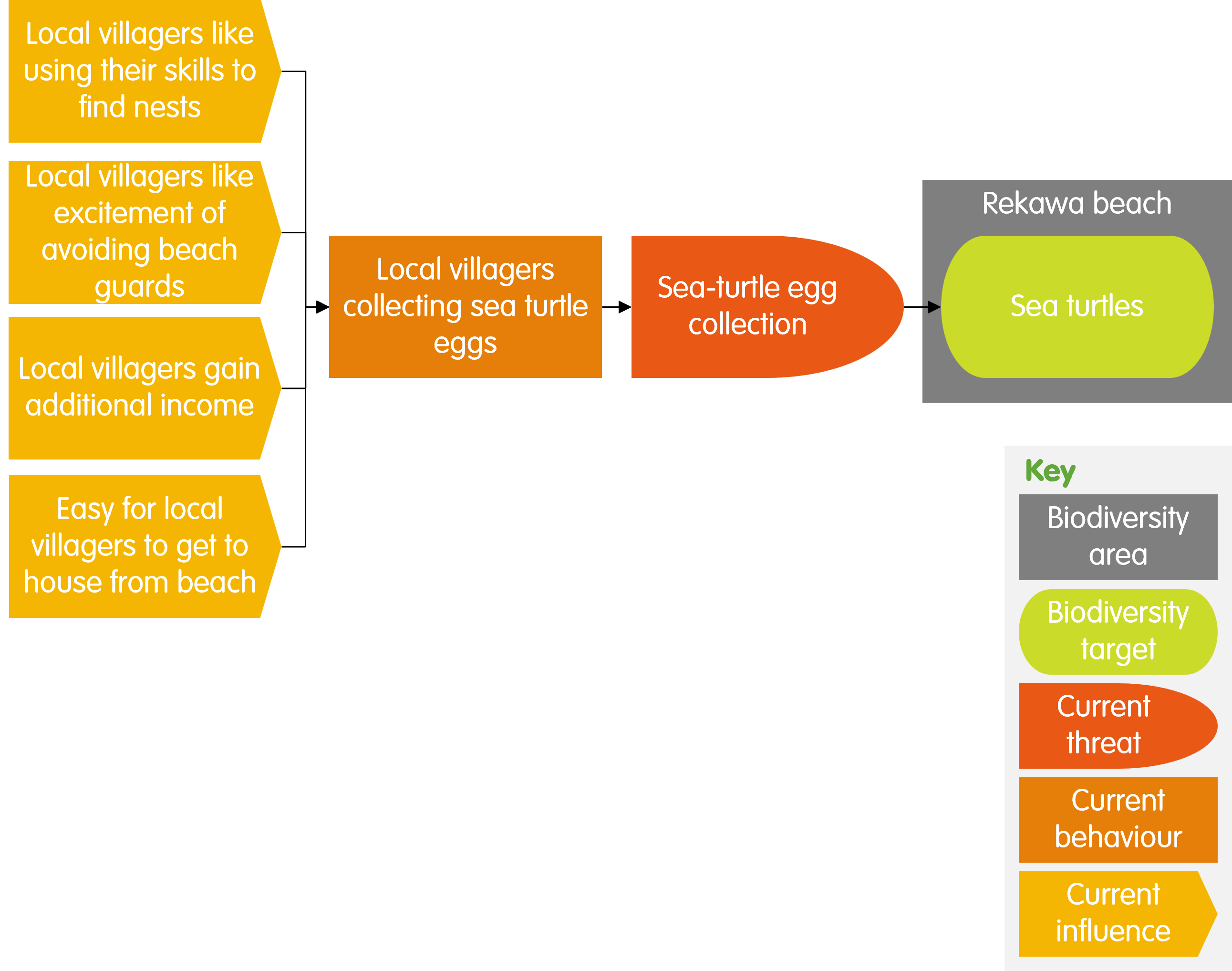
Step 1: Assessing the current situation: Understanding and documenting what's happening now. You select your biodiversity area and biodiversity targets, identify threats directly degrading those targets, assess threat severity, and trace back to understand the human behaviours and influences driving those threats. This assessment creates your current situation diagram showing the cause-and-effect chains from influences → behaviours → threats → biodiversity degradation.
Step 2: Planning the impact: Defining what you want to achieve. You document planned biodiversity target results (improved status), planned threat results (reduced or ceased threats), planned behaviour results (changed behaviours), and planned influence results (new or changed influences). This creates your planned change diagram showing the transformation from current situation to desired future state.
Step 3: Planning the work: Identifying what you'll do to achieve that impact. You select strategic intervention points in your planned change diagram, identify work packages that will directly achieve planned results at those points, assess work package feasibility (capacity and consent), and select the optimal combination of work packages that will achieve maximum impact for minimum investment.
The process is sequential because each step builds on the previous one, but it's also iterative, as you learn more, you may return to earlier steps to refine your understanding or adjust your plans.
7 principles that make conservation strategies work
Seven principles guide the entire planning process, preventing common failure modes and strengthening every conservation strategy:
- Do no harm: Ensures you avoid unintentionally causing negative effects to other wildlife or humans.
- Listen to the people: Requires understanding why groups behave in ways that drive threats, and involving those groups in developing solutions.
- Fortify with facts: Demands that your strategy be based on the best available information at every step.
- Think big: Encourages developing strategies that maximise conservation impact, not just deliver comfortable activities.
- Look up: Ensures your project-level strategy aligns with any higher-level strategies (programme, organisation, national, or international).
- Plan ahead: Helps create future-proof strategies by anticipating how conditions will change during your project.
- Make it last: Focuses on achieving impact that continues after your project closes.
These principles work together. For example, listen to the people helps you understand behaviour drivers, fortify with facts ensures you're right about those drivers, think big prevents you from accepting ineffective solutions, and make it last ensures your behaviour change interventions create lasting transformation.
Common conservation planning pitfalls
Starting with favourite activities instead of threats : Teams begin by listing activities they enjoy or know how to do, then try to justify those activities afterwards. This creates strategies disconnected from what biodiversity actually needs. Solution: Always start with biodiversity targets and threats, then work backwards to identify what work will address those threats.
Ignoring human behaviour drivers: Teams document threats but skip the behaviour and influence analysis, jumping straight to work packages. This creates interventions that address symptoms (the threat itself) without understanding causes (why people create that threat). Solution: Always trace back from threats to behaviours to influences before selecting work packages.
Creating strategies beyond capacity: Teams plan work packages requiring skills, resources, or permissions they don't have, then wonder why implementation fails. Solution: Systematically assess work package feasibility (capacity and consent) and either build capacity, secure consent, form partnerships, or select different work packages.
Weak evidence base: Teams build strategies on assumptions, opinions, or outdated information, then cannot defend their choices when questioned. Solution: Reference information sources for every linkage, assign confidence ratings, and identify where additional research is needed.
Disconnection from higher-level plans: Project teams create strategies that contradict or duplicate programme-level or organisational strategies, wasting resources and confusing stakeholders. Solution: Apply the look up principle by ensuring your biodiversity targets and planned results align with any higher-level strategies you're part of.
No consideration of sustainability: Teams plan work that achieves short-term results but cannot be sustained after the project closes, watching impact rapidly reverse. Solution: Apply the make it last principle by including work packages that build local capacity, strengthen institutions, or create community ownership.
Skipping negative effect assessment: Teams focus only on positive biodiversity impact without considering potential harm to other wildlife or human communities, creating ethical failures. Solution: Apply the do no harm principle by systematically identifying potential negative effects and including mitigation work packages.
How this fits into project management
The conservation strategy you create through this planning process becomes the conservation strategy section of your Project plan during the Plan phase. That Project plan also includes sections on monitoring and evaluation, roles, stakeholder engagement, risks, work plan, budget, and references.
Once your Project plan is signed off, you move to the Fund phase (securing resources), Prepare phase (mobilising team and detailed planning), Implement phase (carrying out work packages), and Close phase (evaluation and knowledge transfer). Throughout implementation, you use the Project tracker to manage daily work and the managing change process to adapt your strategy when conditions change significantly.
For complete guidance on the project lifecycle, see the Project Management for Wildlife Conservation best practice and related articles including How to plan a conservation project: From threat analysis to signed-off project plan, Conservation project documents explained: Plans, trackers, and reports that actually matter, and How to manage change in conservation projects: Risks, issues, opportunities, and lessons learned.
The Monitoring and Evaluation for Wildlife Conservation best practice provides detailed guidance on developing the monitoring and evaluation section of your Project plan based on your conservation strategy.
ONE PAYMENT, FULL ACCESS, MAXIMUM VALUE.
Project Management | Project Planning | Grant Writing | Stakeholder Engagement | Monitoring and Evaluation | Launching Your Career | Consulting | Facilitation | Delivering Training | Ethical Decision Making | Human Rights-Based Approach | Free, Prior and Informed Consent
Unlock unlimited learning with the WildTeam Memberships. For £290/year or £29/month, you get full access to every course in our school, including all current courses and all future courses released during your membership. Individual courses cost £190 each. With 11 courses already available, buying them separately would cost £2,090. Memberships give you access to all of them, plus future releases, for less than the price of two.
FAQ
How does this relate to theories of change?
This approach is essentially a theory of change methodology specifically adapted for conservation. The current situation diagram maps the problem theory (how things degrade), and the planned change diagram maps the intervention theory (how you'll improve things). The terminology differs (behaviours and influences rather than generic "assumptions"), but the logic is the same: explicit cause-and-effect chains from activities to ultimate impact.
How does this relate to the Open Standards?
The Project Planning for Wildlife Conservation approach is based on the Open Standards planning step, but with additional guidance on:
- How to create behaviour change focused strategies.
- How to assign confidence.
- How to identify, assess, and select workpackages.
The Project Planning for Wildlife Conservation approach is also designed to be used in conjunction with all other WildTeam approaches e.g. on project management, stakeholder engagement, and monitoring and evaluation.
- How to create behaviour change focused strategies.
- How to assign confidence.
- How to identify, assess, and select workpackages.
The Project Planning for Wildlife Conservation approach is also designed to be used in conjunction with all other WildTeam approaches e.g. on project management, stakeholder engagement, and monitoring and evaluation.
Can one person create a conservation strategy alone?
Yes, but it's better to involve others. One person can follow the process and create diagrams, but applying principles like listen to the people and fortify with facts requires consulting stakeholders and reviewing evidence. Solo practitioners should at minimum seek input from people whose behaviour they're trying to change and review any published studies on similar conservation challenges. Entirely isolated strategy development usually produces weaker strategies.
What's the difference between a conservation strategy and a work plan?
A conservation strategy explains why your work will achieve conservation impact by showing cause-and-effect linkages from influences to behaviours to threats to biodiversity results. A work plan lists what activities you'll do and when. The strategy comes first and justifies the work plan. Without a strategy, a work plan is just a list of activities with no proven connection to impact.
Do I need perfect information before planning my strategy?
No. Apply the fortify with facts principle by using the best available information, but don't wait for perfection. Use confidence ratings to identify where your information is weak, then either accept that uncertainty, plan to fill information gaps through monitoring, or manage uncertainty using project management control processes. Conservation happens in complex, uncertain contexts — waiting for perfect information means watching biodiversity degrade while you research.
How detailed should my current situation diagram be?
Detailed enough to understand key threats and their drivers, but simple enough to communicate and use. Start with major threats, the most important behaviours driving them, and key influences affecting those behaviours. You can always add detail later if needed. A one-page diagram that's actually used is better than a three-page diagram that's too complex to reference.
What's the difference between a threat and a behaviour?
A threat is a direct stressor degrading biodiversity targets (e.g., "river pollution"). A behaviour is a human action causing or driving that threat (e.g., "pesticide spraying by farmers"). They're kept separate because: (a) some threats have no human drivers, (b) multiple behaviours can drive one threat, (c) threats are measured differently than behaviours (extent and severity vs. frequency and participation), and (d) work packages must change influences to change behaviours to reduce threats — keeping them distinct makes intervention logic clear.
What if I can't identify specific human behaviours driving threats?
Some threats have no human drivers (volcanic eruptions, earthquakes). For these, skip behaviour analysis and move to planning impact and work. But most conservation threats do have human drivers — if you're struggling to identify them, you probably need to listen to the people more. Survey, interview, or consult with the groups whose behaviour you suspect is involved. Often what seems like "lack of behaviour information" is actually "didn't ask the right people."
How many work packages should my strategy include?
Only as many as your team can realistically implement. Start by identifying all possible work packages, then ruthlessly prioritise based on strategic intervention points, feasibility, and confidence ratings. Small teams might implement 3-5 work packages; larger programmes might have 15-20 across multiple projects. If your list exceeds what you can manage, either phase work packages over time, partner with other organisations, or narrow your planned impact.
Latest from our blog
Related articles
-
What is conservation project management?
-
When perfect planning kills wildlife
-
Why your conservation project needs one person in charge
-
All conservation projects need a plan phase
-
How to manage risks in conservaion projects
-
Managing meetings in conservation projects
-
Conservation project management glossary: 50+ terms defined
-
Conservation project planning glossary: 20+ terms defined
-
What is conservation monitoring and evaluation?
-
What is conservation stakeholder engagement?
EXPLORE
Success stories
Blog
Courses
Bursaries
Best practices
Team membership
Conservation Trainers Network
JOIN THE CONVERSATION

EMPOWERING CONSERVATIONISTS TO RESTORE NATURE
We give conservationists worldwide the knowledge, the skills, and the community support they need to design and deliver conservation projects that have more impact.
WILDTEAM is a registered charity in England and Wales. Number 1149465. © 2026 by WildTeam
Stay connected with WildTeam
Get practical tools, training insights, and opportunities to help you deliver more effective conservation projects.
Thanks for connecting!