How to manage risks in conservation projects: From identification to response planning
Jan 27
/
Adam Barlow
Quick answer
Risk management in conservation projects means identifying things that haven't happened yet but could negatively affect your project, assessing their potential impact and likelihood, then planning responses to avoid, reduce, transfer, or accept them. Unlike reactive crisis management, effective risk management enables you to prevent problems before they occur, keeping projects on track to achieve planned conservation impact within budget and schedule while minimizing harm to wildlife and people.
Source: WildTeam. (2026). Project Management for Wildlife Conservation v5. WildTeam UK, Cumbria, UK.
Source: WildTeam. (2026). Project Management for Wildlife Conservation v5. WildTeam UK, Cumbria, UK.
UNLOCK OUR FULL BEST PRACTICES AND GET CERTIFIED CONSERVATION SKILLS
Ready to go deeper?
Build practical skills for wildlife conservation by exploring our expert-led courses designed to help you apply what you’ve learned in real-world contexts. From career development to technical conservation tools, our training is built to support your next step.
Contents
-
Why most conservation projects fail to manage risks effectively
-
Understanding what qualifies as a project risk
-
How to systematically identify risks before they become problems
-
Assessing risk severity through impact and likelihood scoring
-
Selecting appropriate responses for different risk types
-
Implementing risk responses and tracking effectiveness
-
When risks become issues requiring exception handling
-
FAQ
Why standard project management fails conservation
Conservation teams often confuse being busy with being prepared. They implement activities, hold meetings, produce reports, but when unexpected problems emerge they're caught off guard. A key staff member leaves unexpectedly. A government policy changes overnight. Local community support evaporates. The monsoon arrives three weeks early. Suddenly the project is in crisis mode, scrambling to respond while activities stall and budgets hemorrhage.
The pattern is predictable because most conservation projects treat risk management as paperwork rather than practice. Teams create risk registers during proposal writing to satisfy donors, then file them away and never look at them again. When problems eventually materialize, everyone acts surprised despite warning signs that existed for months.This reactive approach wastes extraordinary resources. Research shows projects spend five to ten times more managing issues (problems that have already occurred) than they would have spent managing the same situations as risks (problems identified before they occurred).
A staff departure you saw coming six months ago and planned for costs a few weeks of transition time. The same departure you didn't plan for can derail critical activities for months while you scramble to recruit, hire, and train a replacement.The fundamental challenge is that conservation happens in complex, uncertain environments where countless factors beyond your control can derail even well planned work. You cannot eliminate uncertainty, but you can systematically identify what might go wrong, assess how badly it would hurt, and prepare responses that minimize damage. Risk management transforms "this terrible thing just happened to us" into "we anticipated this possibility and already have a plan."
The pattern is predictable because most conservation projects treat risk management as paperwork rather than practice. Teams create risk registers during proposal writing to satisfy donors, then file them away and never look at them again. When problems eventually materialize, everyone acts surprised despite warning signs that existed for months.This reactive approach wastes extraordinary resources. Research shows projects spend five to ten times more managing issues (problems that have already occurred) than they would have spent managing the same situations as risks (problems identified before they occurred).
A staff departure you saw coming six months ago and planned for costs a few weeks of transition time. The same departure you didn't plan for can derail critical activities for months while you scramble to recruit, hire, and train a replacement.The fundamental challenge is that conservation happens in complex, uncertain environments where countless factors beyond your control can derail even well planned work. You cannot eliminate uncertainty, but you can systematically identify what might go wrong, assess how badly it would hurt, and prepare responses that minimize damage. Risk management transforms "this terrible thing just happened to us" into "we anticipated this possibility and already have a plan."
Understanding what qualifies as a project risk
A risk is something that has not happened yet but, if it did happen, would negatively affect the project impact, budget, or schedule, or create negative effects on other wildlife or humans. This definition has three key components.
Not happened yet means risks are future possibilities. The moment something starts happening or has already happened, it becomes an issue, not a risk. "The Project Manager might leave" is a risk. "The Project Manager has resigned" is an issue. This distinction matters because you manage risks to prevent them becoming issues, while you manage issues to minimize damage already occurring.
Negatively affect means risks create problems, not opportunities. Something that could improve your project is an opportunity (a different category requiring different responses). "A government crackdown on wildlife trafficking might make our anti poaching work more effective" is an opportunity. "A government crackdown on NGOs might prevent us from operating" is a risk. Both are future possibilities, but one helps while the other hurts.
Affect the project or others means risks can harm your conservation outcomes, timelines, budgets, or cause unintended damage to wildlife and people. "Delayed government permits might prevent habitat restoration during the optimal planting season" affects schedule and impact. "Community awareness activities might inadvertently reveal protected species locations to poachers" affects other wildlife. Both qualify as risks requiring management.
Examples of genuine project risks include: monsoon arriving earlier than usual could reduce survey time, key donor might withdraw funding if political situation deteriorates, community members might oppose project activities after misinformation spreads, vehicle breakdown might prevent access to remote field sites during critical monitoring period, or trained field staff might leave for better paying jobs with other organizations.
Examples of things that are not risks: "We need more budget" (this is a gap in planning, not a future possibility). "The team doesn't have required skills" (this is a current capacity issue, not something that might happen). "Poaching is increasing" (this is a threat to biodiversity, not a risk to your project, unless you're specifically concerned that increasing poaching might overwhelm your anti poaching efforts).
How to systematically identify risks before they become problems
Risk identification happens continuously throughout the project lifecycle, but key identification moments exist during project planning and at every status meeting during implementation. The process requires creating an environment where team members feel comfortable raising concerns without being viewed as negative or obstructive.
During project planning, the Project Manager leads the team through systematic identification by examining each element of the Project Plan and asking "what could prevent us from achieving this?" For the conservation strategy, examine each work package: What could prevent us from implementing this work? What could reduce its effectiveness? For the stakeholder engagement plan: What could cause stakeholder relationships to deteriorate? For the monitoring plan: What could prevent us collecting required data?
This systematic review should consider both the immediate project environment (day to day management issues like staff availability, equipment functionality, site access) and wider environment (contextual factors like government policy changes, economic conditions, climate variability, political stability).
During status meetings, risk identification follows a structured discussion format. The agenda includes time for every team member to share any new information or changing conditions they've observed. This democratizes risk identification, recognizing that the person in the field or working directly with communities often spots emerging risks before project leadership does.
The Project Manager should specifically prompt different types of risk identification: "Has anyone noticed changes in community attitudes?" "Are there any upcoming events that might affect our work?" "Has anyone heard about policy changes that could affect our permissions?" "Are equipment or supplies showing signs of potential failure?" Generic questions like "any risks to report?" rarely surface useful information because people don't think in those abstract terms.
Creating psychological safety is critical for effective risk identification. Team members must believe that raising potential problems is valued, not punished. If someone identifies a risk and the response is defensive ("that won't happen, you're being too pessimistic") or dismissive ("we can't worry about every little thing"), people stop identifying risks and problems fester until they become crises.
Sources for risk identification include team member observations, stakeholder feedback, monitoring data trends, similar project experiences (lessons learned from other organizations), published research on conservation interventions, regional news and policy developments, climate forecasts, economic indicators, and political analysis. The wider your information sources, the more effectively you identify emerging risks before they materialize.
Common risk categories to systematically review include: staff turnover, equipment failure, transportation breakdowns, access restrictions, permit delays, funding interruptions, partnership breakdowns, community opposition, government policy changes, weather extremes, disease outbreaks, security threats, and information technology failures. Creating a checklist of these categories helps ensure nothing obvious is missed.
Assessing risk severity through impact and likelihood scoring
Once identified, risks must be assessed to determine which require immediate attention and resource investment versus which can be accepted or monitored. Assessment uses two dimensions: the effect if the risk occurs, and the likelihood of it occurring.
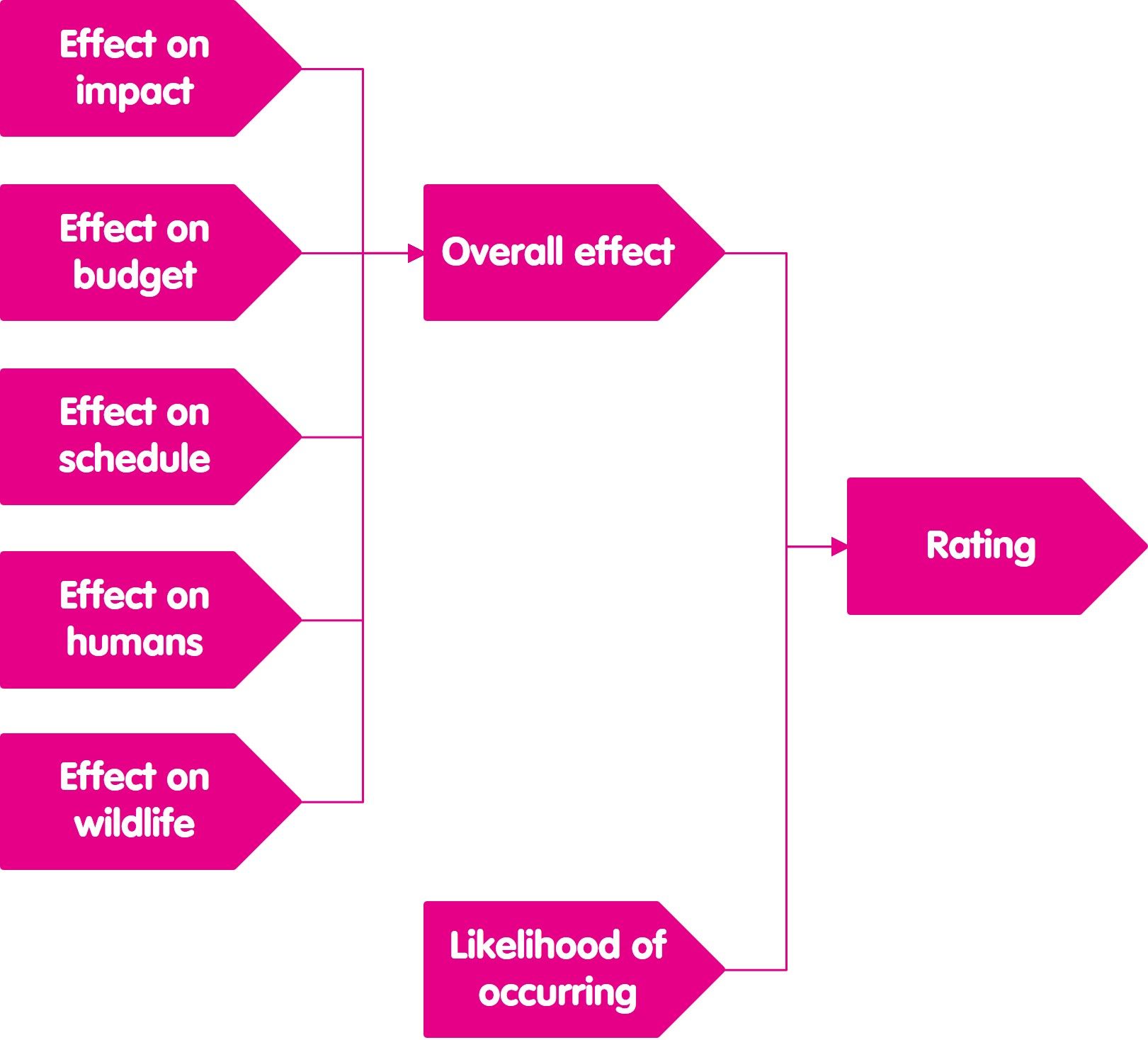
Effect scoring rates how badly the risk would affect the project across four categories (impact, schedule, budget, negative effects) if it occurred. Each category receives its own score based on a defined scale:
For impact effects: Very high means core conservation results cannot be achieved. High means significant reduction in planned conservation results. Medium means moderate reduction in planned results. Low means minimal reduction in planned results.
For schedule effects: Very high means delays exceeding one year. High means delays of six to twelve months. Medium means delays of one to six months. Low means delays under one month.
For budget effects: Very high means additional costs exceeding available contingency. High means additional costs consuming most contingency. Medium means additional costs within planned contingency. Low means minimal additional costs.
For negative effects: Very high means severe, irreversible harm to other wildlife or humans. High means significant harm requiring major mitigation. Medium means moderate harm with available mitigation. Low means minimal harm easily mitigated.
The Project Tracker automatically combines these four category scores to generate an overall effect score for each risk. This ensures risks affecting multiple categories receive appropriately high priority.
Likelihood scoring rates the probability of the risk occurring on a five point scale: Certain means the risk will definitely occur (note: if something is certain, it's probably an issue not a risk). Very likely means high probability, often based on similar situations. Likely means moderate probability. Unlikely means low probability. Very unlikely means remote probability.
Likelihood assessment should be based on available evidence, not gut feelings. If staff turnover is historically 40% annually, a risk of key staff leaving is "likely" not "unlikely." If similar projects in the region have experienced government permit delays 80% of the time, permit delays are "very likely" for your project. If weather forecasts predict unusual monsoon patterns, schedule risks from weather are "likely" not "unlikely."
Overall risk rating combines effect and likelihood scores through a calculation matrix. Very high effect plus very likely occurrence equals high overall rating. Low effect plus unlikely occurrence equals low overall rating. Medium effect plus likely occurrence equals medium overall rating. The matrix handles all combinations systematically.
This calculation determines response priority: high rated risks require immediate response planning and active management, medium rated risks require response planning and regular monitoring, low rated risks can be accepted with occasional review.
For example, the risk "key Workstream Leader might leave for new job" might be assessed as: medium effect on impact (work continues but with reduced effectiveness during transition), medium effect on schedule (some activities delayed during recruitment and training), medium effect on budget (recruitment costs within contingency), low effect on negative outcomes (no harm to others). With likelihood assessed as "likely" based on discussions suggesting job searching behavior, the overall rating would be medium, requiring response planning.
Selecting appropriate responses for different risk types
Once assessed, each medium and high rated risk requires a response strategy selected from four options: avoid, transfer, reduce, or accept. The choice depends on the risk's nature, your control over contributing factors, and cost effectiveness of different responses.
Avoid response means taking actions to prevent the risk from occurring at all. This is only possible for risks where you can eliminate or completely prevent the trigger. Examples include rescheduling field work to avoid predicted extreme weather, changing workshop venues to avoid areas with security threats, selecting equipment with better reliability records to avoid breakdown risks, or adjusting stakeholder engagement timing to avoid local festivals that would prevent participation. Avoid responses work when you have direct control over the factors that would trigger the risk. You cannot avoid a government policy change, but you can avoid scheduling critical activities during periods when policy changes are likely being debated. You cannot avoid currency fluctuations, but you can avoid exchange rate risks by securing funds in local currency before exchange rates shift.
Transfer response means shifting responsibility for managing the risk to another organization or party better positioned to handle it. Examples include partnering with organizations that have required government relationships to transfer permit delay risks, contracting specialist security firms to transfer safety risks in high risk areas, purchasing insurance to transfer equipment damage or loss risks, or subcontracting technically complex work to specialist organizations to transfer technical failure risks. Transfer responses acknowledge that some risks exceed your organizational capacity or expertise. An organization without security expertise should transfer security management to specialists rather than attempting amateur risk management in dangerous contexts. Small organizations without legal departments should transfer contractual risks by engaging lawyers for complex agreements.Transfer does not mean abandoning responsibility entirely, it means engaging appropriate expertise. You remain accountable for identifying the risk and ensuring the transfer is effective, but execution moves to parties with relevant capacity.
Reduce response means taking actions to decrease either the likelihood of the risk occurring or the severity of its effect if it does occur. This is the most commonly used response because many risks cannot be completely avoided or transferred but can be substantially mitigated. Examples include cross training staff to reduce reliance on individuals (reducing effect of staff departure), building relationships with multiple suppliers to reduce procurement delay risks, developing backup data storage to reduce data loss risks, or engaging community members in early planning to reduce opposition risks. Reduce responses recognize that you operate in uncertain environments where complete risk elimination is impossible, but thoughtful preparation can substantially decrease problems. You cannot prevent staff illnesses, but maintaining detailed handover documents reduces the disruption when someone is unexpectedly absent. You cannot prevent equipment breakdowns, but carrying spare parts reduces downtime.The key is selecting reduce actions whose cost is proportional to the risk severity. Spending $5,000 on backup systems to prevent a $500 data loss risk makes no sense. Spending $500 on backup systems to prevent losing years of irreplaceable monitoring data makes perfect sense.
Accept response means consciously deciding to take no proactive action and accepting the potential consequences if the risk occurs. This is appropriate when the risk rating is low, when response costs exceed potential damage, or when the risk is completely outside your control and cannot be avoided, transferred, or reduced.
Examples include accepting minor schedule delays from occasional vehicle maintenance, accepting small budget variances from exchange rate fluctuations, accepting that some planned workshop participants might not attend due to personal circumstances, or accepting that some planned activities might need rescheduling due to weather.
Accept responses must be conscious decisions documented in the Project Tracker, not passive neglect. The difference is that after assessing a risk as low rated, you explicitly record "accept: minimal effect on project outcomes, monitoring via monthly status reviews" rather than simply ignoring it. This ensures accept decisions are reviewed if circumstances change and the risk rating increases.
Implementing risk responses and tracking effectiveness
Selected responses must be translated into specific actions integrated into the project work plan. Risk responses are not separate activities that happen "when we get time," they are prioritised work that prevents much more expensive problem solving later.
Action planning converts each response into concrete tasks with assigned responsibility, deadlines, and resource allocation. "Reduce risk of staff departure" becomes "Project Manager to conduct retention interviews with all key staff by end of month, develop individual development plans by following month, implement salary adjustment if budget allows." "Avoid risk of permit delays" becomes "Workstream Leader to submit permit applications three months ahead of required approval date, maintain weekly follow up contact with permit authority."
Actions should be specific enough that anyone reviewing the Project Tracker understands exactly what will be done, by whom, and when. Vague response descriptions like "monitor situation" or "manage appropriately" indicate incomplete planning. Useful response descriptions detail the actual work: "Project Manager to review supplier performance monthly and develop backup supplier list by Q2."
Integration into work plan means risk response actions appear in the Project Tracker alongside other planned activities, with assigned milestones, tasks, and timelines. This prevents risk management becoming an afterthought that never receives attention when teams are busy delivering conservation work. If staff retention interviews are scheduled in the work plan like any other project activity, they get done. If they exist only in a risk register separate from the work plan, they get perpetually postponed.
Budget for risk response actions must come from somewhere. Small response costs can use contingency funds. Larger costs may require adjusting work package budgets or seeking additional funds. If risk response actions require budget but none is allocated, they won't happen and the risk becomes an accepted risk by default, whether intended or not.
Predicted scores after response should be recorded in the Project Tracker showing the expected effect and likelihood if the response actions are successfully implemented. This creates accountability for ensuring responses actually work. If you claim a reduce response will lower likelihood from "likely" to "unlikely," but after implementing the response the situation hasn't changed, your response was ineffective and needs revision.
For example, the risk "key staff might leave" with medium overall rating might have a reduce response: "implement retention package including professional development opportunities and recognition." After implementing this response, you predict the likelihood decreases from "likely" to "unlikely" and effect decreases from "medium" to "low" because remaining staff are cross trained. The overall predicted rating becomes low, meaning the risk can shift to acceptance with periodic monitoring.
Monitoring and review happens through regular status meetings where the Project Manager reviews current risk status. For each risk, the team confirms whether circumstances have changed (affecting likelihood or effect scores), whether planned response actions are on track, and whether responses are proving effective. Risks whose ratings have decreased due to effective responses can be downgraded to accept. Risks whose ratings have increased despite responses require escalation or different response strategies.
The Project Tracker risk register becomes a living document updated continuously as new risks emerge, existing risks evolve, and responses prove effective or ineffective. Teams should review the complete risk register monthly at a minimum, with weekly reviews for high rated risks requiring active management.
When risks become issues requiring exception handling
Despite effective risk management, some risks will materialize and some issues will emerge unexpectedly. The moment a risk occurs or an issue is identified, management shifts from preventing problems to minimizing damage. This shift has important implications for how projects adapt.
Issue identification means recognizing that something is already happening or has happened that negatively affects the project. The clearest indicator is that you can no longer achieve your Project Plan as written. Planned conservation results are at risk, deadlines will be missed, budget will be exceeded, or negative effects to others are occurring despite mitigation efforts.
Issues receive the same four category assessment as risks (impact, schedule, budget, negative effects) but their likelihood score is automatically "certain" because they're already happening. This typically produces high overall ratings because something already occurring with significant effect rates high regardless of probability.
High rated issues trigger exception status, meaning the project can no longer achieve and follow the Project Plan. This is not a failure, it's an acknowledgment that circumstances have changed enough that the original plan is no longer viable. Exception status initiates formal adaptation rather than pretending you can soldier on with an unachievable plan.
The Project Manager produces an Exception Report documenting how the issue prevents achieving the Project Plan despite planned responses, and an Adaptation Plan suggesting updated conservation strategy, results, schedule, or budget. These documents go to the Project Director for decision on whether to authorize the updated plan or close the project.
Exception decisions balance three factors: Can the updated plan still achieve impact worth the investment? Can available funds be applied to the updated budget? Would continuing the project avoid or create unacceptable harm? If answers are yes, yes, and avoid, the Project Director authorizes the Adaptation Plan and the Project Manager updates the Project Plan. If answers suggest continuing would waste resources or cause harm, the Project Director may decide project closure is more responsible than continuing.
For example, if a key partnership collapses and that partner was providing 60% of planned fieldwork capacity, you're in exception. The Exception Report explains that without this partner, planned conservation results cannot be achieved within budget and schedule. The Adaptation Plan might propose reduced geographic scope, longer implementation timeline, and partnership with a different organization to replace lost capacity. If the Project Director judges this adapted approach is still worthwhile, they authorize the updated plan. If they judge the reduced scope no longer justifies the investment, they may decide to close the project and redirect resources to more promising opportunities.
Learning from exception events matters because patterns often emerge. If your projects repeatedly go into exception due to similar risks (staff turnover, permit delays, community opposition), your risk management needs strengthening in those areas. If exception events are truly unpredictable (earthquakes, coups, pandemics), that indicates you're operating in high uncertainty environments requiring more flexible planning and larger contingencies.
The goal is not to never experience exception (this is unrealistic in conservation's uncertain contexts) but to catch problems early when adaptation is still possible rather than late when only crisis management remains.
ONE PAYMENT, FULL ACCESS, MAXIMUM VALUE.
Project Management | Project Planning | Grant Writing | Stakeholder Engagement | Monitoring and Evaluation | Launching Your Career | Consulting | Facilitation | Delivering Training | Ethical Decision Making | Human Rights-Based Approach | Free, Prior and Informed Consent
Unlock unlimited learning with the WildTeam Memberships. For £290/year or £29/month, you get full access to every course in our school, including all current courses and all future courses released during your membership. Individual courses cost £190 each. With 11 courses already available, buying them separately would cost £2,090. Memberships give you access to all of them, plus future releases, for less than the price of two.
FAQ
What's the difference between a risk and an issue?
A risk is something that might happen in the future but hasn't yet. An issue is something already happening or that has happened. The moment a risk materializes, it becomes an issue. For example, "key staff member might leave" is a risk, "key staff member has resigned" is an issue. This distinction matters because you manage risks to prevent them, while you manage issues to minimize damage already occurring.
Should we assess risks during proposal writing or wait until implementation?
Assess during proposal writing because donors expect to see risk awareness and many risks are predictable during planning. But risk management must continue throughout implementation as new risks emerge and existing risks evolve. The proposal risk register is your starting point, not your complete list. Plan to update it at least monthly during implementation.
What if our organization lacks capacity to implement selected risk responses?
This is itself a risk requiring response. Options include building internal capacity through training, partnering with organizations that have required capacity, transferring risk management to specialist organizations, accepting higher risk levels with informed consent from leadership, or reconsidering whether you should implement the project at all if risks exceed your management capacity.
Can we use quantitative probability percentages instead of qualitative likelihood ratings?
You can if you have data supporting quantitative estimates, but most conservation contexts lack sufficient historical data for accurate probability calculations. Qualitative ratings acknowledge uncertainty while still enabling prioritization. If your organization has strong quantitative data from many similar projects, percentages can work, but most teams find qualitative scales more practical and defendable.
What if team members identify risks but Project Manager dismisses them?
This indicates poor risk management culture and will cause team members to stop identifying risks. Senior leadership should establish that risk identification is valued and that all risks raised will be assessed objectively rather than dismissed. If dismissals continue, escalate to the Project Director. Suppressing risk identification guarantees problems will emerge as crises rather than managed risks.
How do we manage risks we have no control over like government policy changes?
You cannot control external factors, but you can prepare responses. For policy risks, responses might include monitoring policy discussions to enable early adaptation, building relationships with government to stay informed, designing flexible strategies that work under multiple policy scenarios, or transferring policy management risk to partners with stronger government connections. Accept that some risks can only be monitored and adapted to, not prevented.
Latest from our blog
Related articles
-
What is conservation project management?
-
When perfect planning kills wildlife
-
Why your conservation project needs one person in charge
-
All conservation projects need a plan phase
-
Managing meetings in conservation projects
-
Conservation project management glossary: 50+ terms defined
-
What is conservation project planning?
-
What is conservation monitoring and evaluation?
-
What is conservation stakeholder engagement?
EXPLORE
Success stories
Blog
Courses
Bursaries
Best practices
Team membership
Conservation Trainers Network
JOIN THE CONVERSATION

EMPOWERING CONSERVATIONISTS TO RESTORE NATURE
We give conservationists worldwide the knowledge, the skills, and the community support they need to design and deliver conservation projects that have more impact.
WILDTEAM is a registered charity in England and Wales. Number 1149465. © 2026 by WildTeam
Stay connected with WildTeam
Get practical tools, training insights, and opportunities to help you deliver more effective conservation projects.
Thanks for connecting!