
Why your conservation project needs one person in charge: The project manager role explained
Jan 27
/
Adam Barlow

Quick answer
The Project manager is the only mandatory role in conservation project management, responsible for day-to-day project execution and reporting while the project stays on track to achieve its planned impact. This role holds decision-making authority over daily operations, coordinates all workstreams, manages control processes, and serves as the central point of accountability.
Without a designated Project manager, conservation projects suffer from duplicated effort, delayed decisions, unclear accountability, and wasted resources. The role can be combined with other roles in small projects but must always be explicitly assigned to one person.
Without a designated Project manager, conservation projects suffer from duplicated effort, delayed decisions, unclear accountability, and wasted resources. The role can be combined with other roles in small projects but must always be explicitly assigned to one person.
The Project manager role is central to the Project Management for Wildlife Conservation best practice framework, the standard peer-reviewed methodology used by conservation professionals worldwide to deliver measurable biodiversity impact through well-structured projects.

UNLOCK OUR FULL BEST PRACTICES AND GET CERTIFIED CONSERVATION SKILLS
Ready to go deeper?
Build practical skills for wildlife conservation by exploring our expert-led courses designed to help you apply what you’ve learned in real-world contexts. From career development to technical conservation tools, our training is built to support your next step.
Contents
-
Why conservation projects fail without clear project management
-
What the Project manager role actually does
-
Decision-making authority: what the Project manager can and cannot decide
-
How the Project manager role connects to other roles
-
Assigning the Project manager role: who and when
-
Tools and practices for effective Project management
-
Advanced application: when NOT to "do something"
-
FAQ
Why conservation projects fail without clear project management
Conservation organizations often operate under a dangerous myth: that passionate, skilled conservationists working toward shared goals will naturally coordinate effectively without formal management structures. The reality is brutally different.
Projects without designated project managers experience decision-making paralysis when team members hold different opinions about priorities, resource allocation, or tactical approaches. No one has clear authority to make final decisions, so debates drag on while threats continue degrading biodiversity. When decisions finally get made, they're often based on whoever argues loudest or longest rather than strategic merit.
Work gets duplicated because no one has overall visibility of who's doing what. Three people independently develop monitoring protocols because no central coordinator knows all three are working on it. Or conversely, critical tasks fall through gaps because everyone assumes someone else is handling them. The community engagement workshop never happens because the field team thought the communications team was organizing it, while the communications team thought the field team was handling it.
Reporting becomes a nightmare. Each team member tracks progress differently, using incompatible formats and metrics. The finance team has one version of budget status, the field team has another, and the donor receives a third version cobbled together at the last minute. No one has a complete, accurate picture of project status because no one is responsible for maintaining that picture.
Control processes either don't happen or happen ineffectively. Risks get identified but never assessed or managed because no one owns the risk register. Issues emerge but responses are delayed because it's unclear who has authority to authorize solutions. Lessons learned never get documented because everyone's too busy firefighting to capture knowledge.
The most damaging consequence is erosion of the "Take responsibility" principle. When it's unclear who manages the project, team members stop taking ownership of problems. "That's not my responsibility" becomes the default response. Energy that should go toward conservation impact gets channeled into territorial disputes, blame-shifting, and covering for organizational dysfunction.
The Project manager role solves all these problems by creating one person with clear authority and accountability for daily project execution.
What the Project manager role actually does
The Project manager is responsible for carrying out and reporting on day-to-day project management. This deceptively simple description encompasses several critical functions:
Coordinating all project work means the Project manager maintains visibility across all workstreams, understands dependencies between work packages, identifies conflicts or gaps, and ensures team members have what they need to deliver their work. The Project manager doesn't necessarily do all the work themselves but ensures it all gets done in the right sequence at the right time.
Making operational decisions means the Project manager has authority to make any decision about the day-to-day running of the project, as long as the project remains on track to achieve the Project plan. This includes decisions about resource allocation, task prioritization, problem-solving approaches, minor adjustments to schedules, and implementation tactics. The Project manager cannot make decisions that would take the project off track from achieving its planned impact, those decisions require escalation to the Project director.
Managing control processes means the Project manager ensures the project team properly identifies, documents, assesses, and responds to risks, issues, opportunities, and lessons learned. The Project manager chairs status meetings, maintains the Project tracker, updates risk and issue registers, and triggers the managing change process when needed. This is not bureaucratic overhead, it's the mechanism that keeps projects adaptive and responsive.
Reporting project status means the Project manager produces regular progress reports for the Project director, Leader, donors, and other stakeholders. These reports accurately reflect project status against the Project plan, highlight significant risks or issues, and provide early warning when problems threaten to take the project into exception. Honest, timely reporting is perhaps the Project manager's most important accountability function.
Serving as primary point of contact means the Project manager is the go-to person for questions about project status, decisions about daily operations, coordination between team members, and escalation of problems requiring higher authority. This doesn't mean the Project manager answers every question personally but ensures questions get routed to the right people for answers.
The Project manager role is distinct from the Project director (who oversees the project and has authority over Project plan changes) and the Project planner (who produces the Project plan and raises funds). In many conservation projects, especially small ones, the same person holds multiple roles. One individual might be both Project planner and Project manager, or Project manager and Workstream leader. But even when roles are combined, the Project manager responsibilities must be explicitly assigned and understood.
Decision-making authority: what the Project manager can and cannot decide
Understanding the Project manager's decision-making authority is critical for effective project execution. The authority boundary is clear: the Project manager can make any decision about day-to-day project running, as long as the project stays on track to achieve the Project plan.
Decisions the Project manager CAN make without escalation:
Resource allocation within approved budget includes moving money between budget lines to respond to changing needs, as long as total budget and planned impact remain achievable. For example, if monitoring equipment costs less than expected, the Project manager can reallocate those savings to increase community engagement activities without seeking Project director approval.
Task prioritization and sequencing includes deciding which activities to complete first when schedule pressures emerge, adjusting the sequence of work packages if dependencies change, or accelerating certain work to take advantage of opportunities. For example, if unexpected good weather creates an opportunity to complete habitat surveys earlier, the Project manager can reprioritize field team schedules without escalation.
Problem-solving approaches includes deciding how to address implementation challenges, selecting among alternative methods for delivering work packages, or adjusting tactics when initial approaches prove ineffective. For example, if planned community workshops have low attendance, the Project manager can switch to smaller household visits without seeking approval, as long as the planned behaviour change results remain achievable.
Minor schedule adjustments includes sliding individual milestones forward or backward by days or weeks to accommodate changing conditions, as long as major phase deadlines remain achievable. For example, if key stakeholders are unavailable for a planned meeting, the Project manager can reschedule without escalation.
Team coordination decisions includes assigning tasks to team members, creating temporary working groups to address specific challenges, establishing communication protocols, or adjusting how workstreams interact. For example, if two workstreams need to coordinate more closely, the Project manager can establish joint planning meetings without seeking approval.
Decisions the Project manager CANNOT make without escalation:
Decisions the Project manager CANNOT make without escalation:
Any change that would take the project into exception, meaning the project cannot achieve its planned impact within the approved schedule and budget. These decisions must be escalated to the Project director, who has authority to approve Project plan changes. For example, if a major risk materializes that will prevent achieving planned biodiversity results, the Project manager must escalate to the Project director rather than making unauthorized changes to planned results.
Changes to planned impact, objectives, or indicators are always outside the Project manager's authority because they fundamentally alter what the project aims to achieve. Even if staying within budget and schedule, the Project manager cannot decide to switch from conserving tigers to conserving elephants without Project director approval.
Addition or removal of work packages that weren't in the original Project plan requires escalation, even if resources are available. The Project plan represents an agreed strategy for achieving impact, changing that strategy requires Project director authority.
Budget increases or major budget reallocations that would require additional fundraising or dramatically shift resources between project components need escalation. The Project manager has flexibility within the approved budget but cannot increase total budget or make changes that would require new donor approvals.
Decisions affecting organizational reputation or stakeholder relationships must be escalated to the Leader role. For example, if a significant conflict with a government partner emerges, the Project manager escalates to the Leader rather than making decisions that could damage the organization's long-term relationships.
This authority boundary enables efficient daily decision-making while maintaining strategic oversight. The Project manager has enough authority to keep the project moving without constant escalation, but serious problems that threaten project success trigger appropriate senior involvement.
How the Project manager role connects to other roles
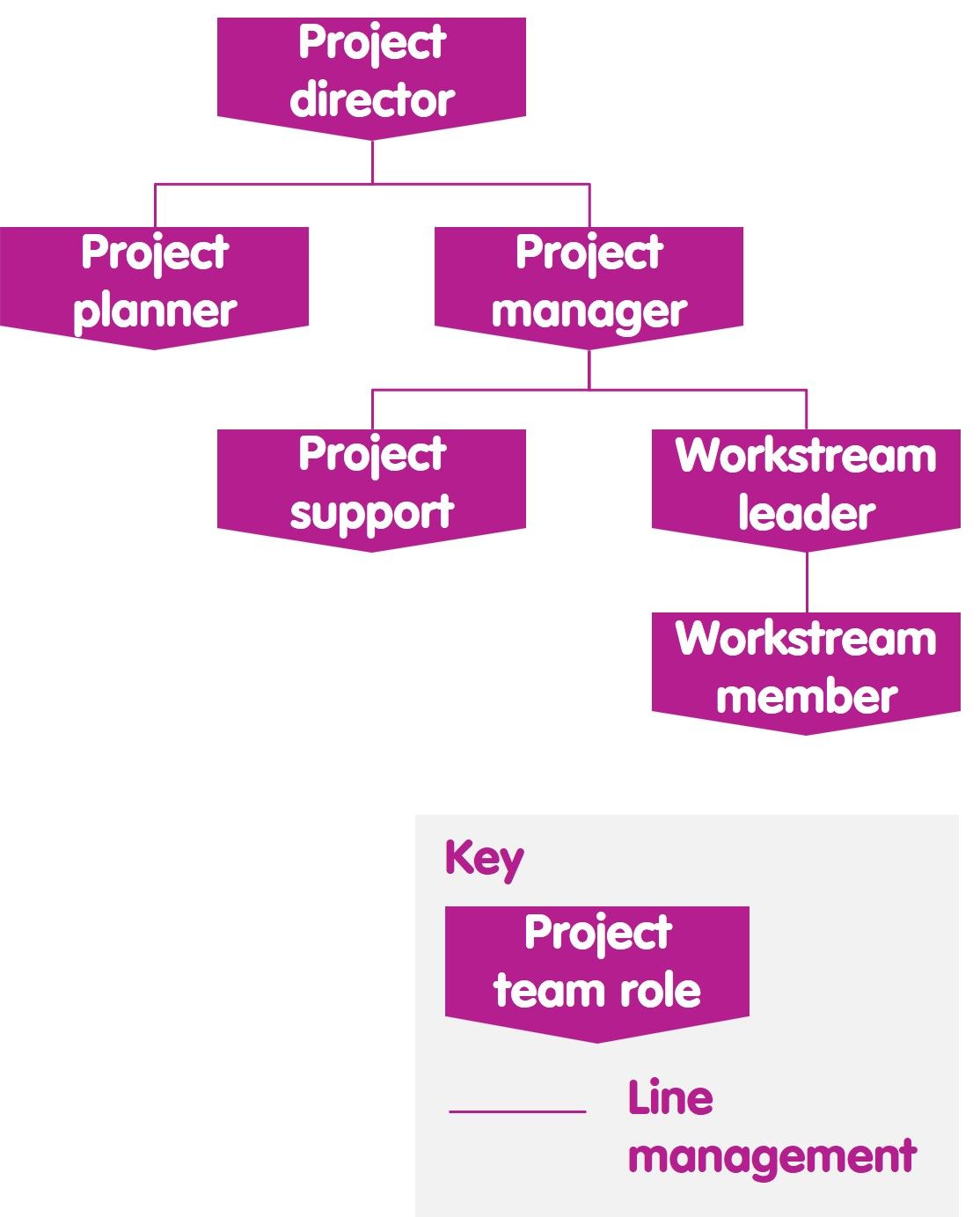
The Project manager sits at the center of the project team structure, connecting upward to oversight roles and downward to delivery roles:
Line management from Project director means the Project manager takes direction from and reports to the Project director. The Project director sets overall project direction, approves major decisions, and holds the Project manager accountable for daily project execution. Regular one-on-one meetings between Project director and Project manager are essential for maintaining alignment.
Coordination with Project planner occurs primarily during the Plan and Fund phases, when the Project planner is developing the Project plan and raising resources. The Project manager may contribute to planning and fundraising but doesn't have authority over these activities. Once implementation begins, the Project planner's active role typically diminishes unless the project requires additional planning or fundraising.
Support from Project support means the Project manager can delegate specific tasks to Project support roles, particularly administrative tasks related to control processes. For example, Project support might maintain the risk register, schedule status meetings, compile progress reports, or track deliverables. The Project manager retains overall responsibility but can assign specific tasks to Project support roles.
Management of Workstream leaders means the Project manager line manages all Workstream leaders, setting priorities, reviewing progress, making decisions about workstream coordination, and escalating workstream issues that threaten overall project success. Workstream leaders have autonomy over their workstream's daily operations but report to the Project manager.
Escalation to Leader happens when issues arise that could affect the lead organization's reputation or require operational support beyond the Project manager's authority. The Leader doesn't typically involve themselves in daily project management but needs visibility of significant risks or issues.
Accountability to Operations support occurs when project operations must comply with organizational policies on finance, human resources, communications, or other operational domains. The Project manager works with Operations support to ensure the project follows organizational policies while still achieving planned impact.
Interface with Project assurance requires the Project manager to provide Project assurance with access to project information, respond to questions about adherence to the Project plan, and implement recommendations from assurance reviews. Project assurance doesn't have decision-making authority but can identify problems requiring the Project manager's attention.
In small conservation projects, many of these roles may be combined. One person might serve as both Project director and Project manager, while another serves as both Workstream leader and Workstream member. But even when roles are combined, understanding the distinct responsibilities and authorities of each role prevents confusion and maintains clear accountability.
Assigning the Project manager role: who and when
The Project manager role must be assigned at the start of the Prepare phase and continues through project closure. This timing is critical: the role must exist before detailed implementation planning begins but doesn't need to be assigned during initial Project plan development (the Project planner handles that).
Selection criteria for effective Project managers:
Management experience matters more than technical expertise. The best Project manager for a marine conservation project might not be the marine biologist with the deepest species knowledge but the person with proven ability to coordinate teams, make decisions, manage budgets, and deliver results. Technical expertise can be found in Workstream leaders and members; management capability must reside in the Project manager.
Decision-making confidence is essential. Effective Project managers can make timely decisions with imperfect information, take responsibility for those decisions, and adjust when new information emerges. People who need perfect certainty or consensus before deciding typically struggle in the Project manager role.
Communication skills enable coordination. Project managers must explain decisions clearly, give constructive feedback, facilitate difficult conversations, report status accurately, and maintain stakeholder confidence. Poor communicators struggle to keep teams aligned and stakeholders informed.
Organizational understanding helps navigation. Project managers who understand the organization's structure, policies, decision-making processes, and political dynamics can navigate organizational complexity more effectively. This is particularly important for conservation projects embedded in larger programmes or organizations.
Assignment approaches for different project sizes:
Small projects (1-5 team members, simple work packages, short duration) might assign the same person as both Project manager and Workstream leader, or even as Project manager, Workstream leader, and Workstream member. This is appropriate when the complexity doesn't justify separate roles. But the Project manager responsibilities must still be explicitly recognized and allocated time.
Medium projects (6-15 team members, multiple workstreams, moderate complexity) typically need a dedicated Project manager who doesn't also serve as Workstream leader. The coordination demands justify having someone focused primarily on management rather than delivery. The Project manager might still hold Workstream member responsibilities for specific tasks but shouldn't be leading multiple workstreams.
Large projects (16+ team members, complex workstreams, extended duration) require a full-time dedicated Project manager who holds no other roles. The coordination complexity, stakeholder management demands, and control process requirements need undivided attention. Large projects might even assign Project support roles to help the Project manager handle administrative workload.
Handling Project manager transitions:
Projects sometimes need to change Project managers mid-implementation due to staff departures, organizational restructuring, or performance issues. Effective transitions require:
- Overlap period where outgoing and incoming Project managers work together for at least two weeks, transferring knowledge about project status, stakeholder relationships, upcoming decisions, and ongoing issues.
- Formal handover documentation including updated Project tracker, current risk and issue registers, recent progress reports, budget status, stakeholder contact information, and explanation of any significant decisions or challenges.
- Stakeholder communication informing team members, Project director, donors, and partners about the transition, introducing the new Project manager, and maintaining confidence in project continuity.
- Authority confirmation ensuring the new Project manager's authority is clearly communicated and supported by the Project director and Leader, preventing any confusion about decision-making during the transition.
Tools and practices for effective Project management
Project tracker as central management tool: The Project tracker is the Project manager's primary tool for daily project management. It consolidates work plans, risk registers, issue logs, opportunity registers, lessons learned, and progress tracking in one accessible location. Effective Project managers update the tracker weekly, use it to prepare for status meetings, and share relevant sections with team members and stakeholders.
Status meetings as coordination mechanism: Regular status meetings (typically weekly or biweekly) are the primary mechanism for team coordination, risk review, issue resolution, and progress assessment. Effective Project managers prepare agendas focused on decisions and actions, keep meetings time-bound, document decisions and actions clearly, and follow up to ensure commitments get delivered.
One-on-ones for individual coordination: While status meetings coordinate the team collectively, regular one-on-one meetings between the Project manager and each Workstream leader maintain individual alignment. These meetings provide opportunities to discuss workstream-specific challenges, give feedback, identify support needs, and surface issues that might not emerge in larger meetings.
Progress reports for accountability: Regular progress reports (monthly or quarterly) to the Project director, Leader, and donors maintain transparency and enable oversight. Effective reports focus on progress against planned results (not just activity completion), highlight significant risks or issues, provide early warning of potential problems, and request decisions or support when needed.
Risk and issue registers for proactive management: Maintaining current risk and issue registers enables proactive problem management. Effective Project managers review risks weekly, update probability and impact ratings as situations change, implement planned responses before risks materialize, and escalate high-rated risks to the Project director.
Budget tracking for resource management: Regular budget tracking (at least monthly) ensures the project stays within financial constraints and enables resource reallocation when needed. Effective Project managers reconcile actual spending against planned budgets, forecast remaining costs, identify variances early, and adjust resource allocation to maximize impact within budget limits.
Stakeholder communication for relationship management: Maintaining regular communication with key stakeholders (government partners, community leaders, donors, NGO partners) prevents relationship problems and enables collaborative problem-solving. Effective Project managers don't wait for scheduled reports but proactively share updates, seek input, and address concerns as they emerge.
ONE PAYMENT, FULL ACCESS, MAXIMUM VALUE.
Project Management | Project Planning | Grant Writing | Stakeholder Engagement | Monitoring and Evaluation | Launching Your Career | Consulting | Facilitation | Delivering Training | Ethical Decision Making | Human Rights-Based Approach | Free, Prior and Informed Consent
Unlock unlimited learning with the WildTeam Memberships. For £290/year or £29/month, you get full access to every course in our school, including all current courses and all future courses released during your membership. Individual courses cost £190 each. With 11 courses already available, buying them separately would cost £2,090. Memberships give you access to all of them, plus future releases, for less than the price of two.
FAQ
Can a project have more than one Project manager?
No. Having multiple Project managers creates confusion about decision-making authority and accountability. If the project is large enough to need multiple managers, structure it with one Project manager overseeing multiple Workstream leaders, each managing their workstream. If the project is actually several distinct projects, structure them as separate projects each with their own Project manager under a programme structure.
What if no one on the team has project management experience?
Then assign the role to whoever has the best combination of decision-making confidence, communication skills, and organizational understanding, and provide training or mentoring. Project management skills can be learned. Alternatively, bring in external project management capacity through hiring, partnerships, or consultancy. But don't avoid assigning the role just because no one is perfectly qualified.
How much time should Project managers spend on management versus delivery?
This depends on project size. Small projects might need only 20-30% management time, large projects might need full-time management attention. A useful rule: if the Project manager is so busy delivering work packages that control processes get neglected, status meetings get skipped, or coordination breaks down, they're spending too much time on delivery and not enough on management.
Should the Project manager also be the technical expert?
Not necessarily. The Project manager needs management skills more than technical expertise. Technical experts should be Workstream leaders or members, providing expertise without needing to manage the entire project. That said, the Project manager needs sufficient technical understanding to make informed decisions, coordinate effectively, and maintain credibility with technical team members.
What happens if the Project manager makes a bad decision?
If the decision is within the Project manager's authority, they own the consequences and work to fix problems caused. If the consequences threaten to take the project into exception, they escalate to the Project director. This is exactly why clear authority boundaries exist. Project managers can and will make mistakes; the management framework ensures mistakes get caught early and addressed appropriately.
How does the Project manager handle conflicts between team members?
By addressing them directly rather than hoping they resolve themselves. First, understand each person's perspective. Second, identify the underlying issue (resource conflicts, unclear responsibilities, personality clashes, different priorities). Third, make a decision or facilitate resolution. Fourth, document the resolution and adjust project processes if needed to prevent recurrence. Avoiding conflicts lets them fester and damage team effectiveness.
Can the Project manager overrule a Workstream leader's decision?
Yes, if that decision affects overall project coordination, conflicts with other workstreams, or threatens to take the project off track. Workstream leaders have autonomy over their workstream's daily operations, but the Project manager maintains authority over decisions that affect the whole project. This should be used judiciously to avoid undermining Workstream leader authority, but the option must exist.
How formal does the Project manager role need to be for small projects?
The responsibilities must be clear even if the process is informal. Small projects can have simple status meetings, basic trackers, and minimal reporting while still maintaining clear Project manager authority and accountability. But someone must be designated as Project manager, that person must understand their responsibilities, and the team must know who makes decisions. Informal doesn't mean vague or nonexistent.
Latest from our blog
Related articles
-
What is conservation project management?
-
When perfect planning kills wildlife
-
All conservation projects need a plan phase
-
How to manage risks in conservaion projects
-
Managing meetings in conservation projects
-
Conservation project management glossary: 50+ terms defined
-
What is conservation project planning?
-
What is conservation monitoring and evaluation?
-
What is conservation stakeholder engagement?
EXPLORE
Success stories
Blog
Courses
Bursaries
Best practices
Team membership
Conservation Trainers Network
JOIN THE CONVERSATION

EMPOWERING CONSERVATIONISTS TO RESTORE NATURE
We give conservationists worldwide the knowledge, the skills, and the community support they need to design and deliver conservation projects that have more impact.
WILDTEAM is a registered charity in England and Wales. Number 1149465. © 2026 by WildTeam
Stay connected with WildTeam
Get practical tools, training insights, and opportunities to help you deliver more effective conservation projects.
Thanks for connecting!